

Burnout Is Not Just Being Tired: Phoenix Hypnotherapist Explains How Stress, Anxiety, and Poor Sleep Are Warning Signs
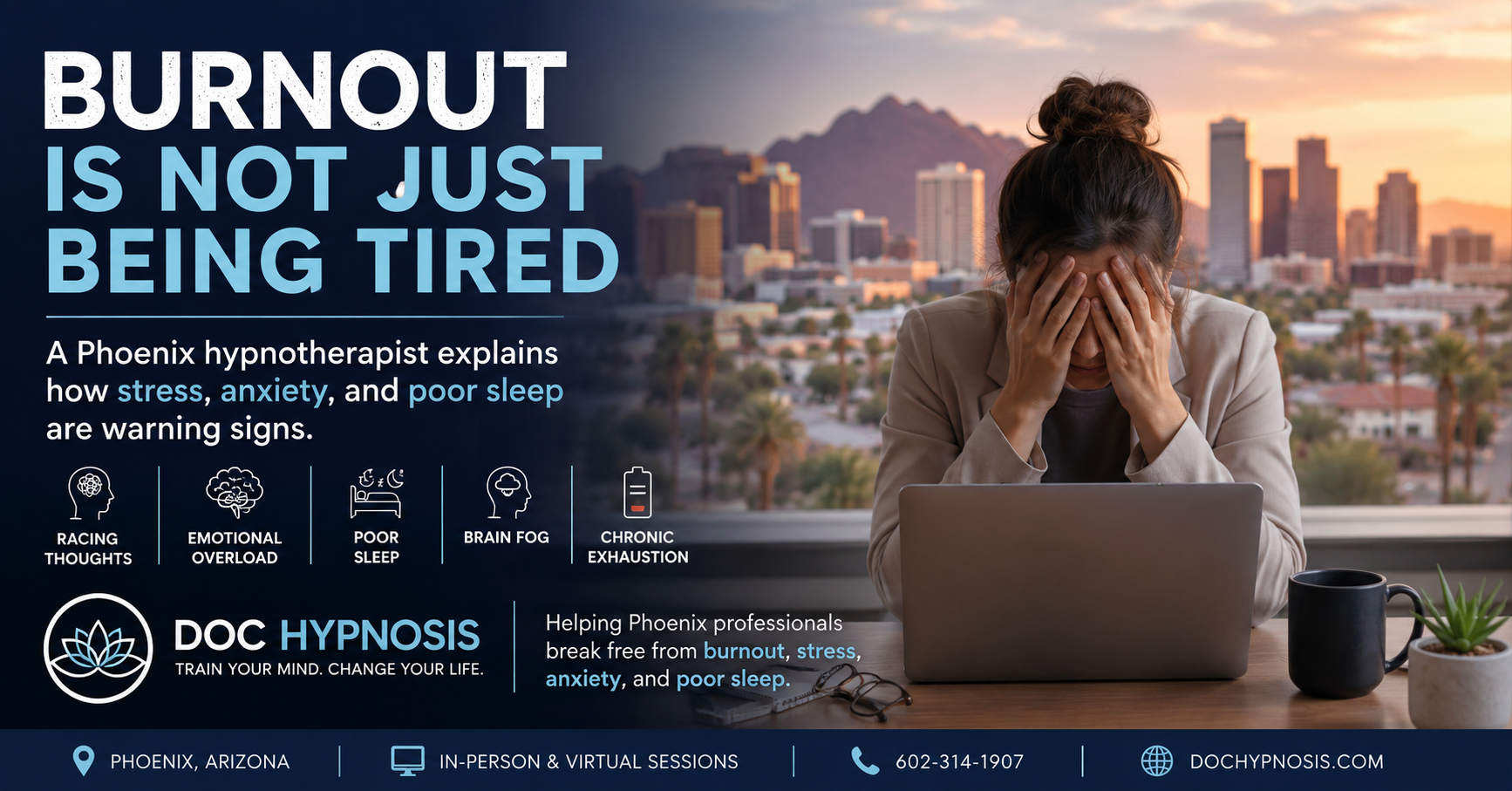
Burnout can appear as racing thoughts, poor sleep, brain fog, emotional overload, and chronic exhaustion. Doc Hypnosis helps Phoenix professionals recognize and address subconscious stress patterns.
Doc Hypnosis reveals how burnout may appear as anxiety, poor sleep, brain fog and emotional overload—and when it may be time to seek support.
Many people think burnout means they need a vacation, more sleep, or a better schedule. But according to Dr. William Deihl, founder of Doc Hypnosis, burnout often shows up in deeper ways long before a person fully recognizes what is happening.
“Burnout is not always loud at first,” said Dr. Deihl. “For many people, it starts as racing thoughts, poor sleep, irritability, anxiety, brain fog, emotional overload, or the feeling that they cannot shut their mind off. They may still be going to work, taking care of others, and handling responsibilities, but inside, their nervous system is running in survival mode.”
Doc Hypnosis is using this public education campaign to help Phoenix professionals recognize the difference between being tired and being burned out. While ordinary tiredness may improve with rest, burnout often feels like a pattern that keeps repeating.
People may rest and still wake up exhausted. They may take a day off and still feel overwhelmed. They may understand that they need to slow down but find that their mind and body will not cooperate.
This is where Doc Hypnosis believes hypnotherapy may play an important supportive role.
Hypnotherapy is not about losing control or being made to do something against one’s will. At Doc Hypnosis, it is used as a focused, professional process to help clients work with subconscious patterns, automatic stress responses, emotional triggers, sleep-related habits, and internal narratives that may keep stress active even after the original pressure has passed.
“Many people know what they should do,” said Dr. Deihl. “They know they should sleep better, set boundaries, stop overthinking, stop checking their phone, take better care of themselves, and relax. But knowing what to do is not always the same as being able to do it. Burnout can become a subconscious pattern. The body learns stress. The mind rehearses pressure. Hypnotherapy helps us work with the part of the mind running those automatic responses.”
Burnout Can Affect More Than Work Performance
Burnout can affect sleep, relationships, confidence, motivation, decision-making, emotional regulation, and physical tension. Many professionals describe feeling like they are always “on,” even when they are supposed to be off.
Others describe a loss of joy, reduced patience, difficulty concentrating, decreased motivation, or a growing sense of disconnection from their work, family, personal goals, or sense of identity.
Doc Hypnosis sees this pattern frequently among professionals who are accustomed to being the responsible one. These are the people who lead teams, solve problems, care for family members, manage businesses, serve clients, and continue showing up even when their internal resources are running low.
“High-functioning burnout can be one of the most difficult patterns to recognize,” said Dr. Deihl. “From the outside, the person may still look successful. They may continue producing, leading, caring, and showing up. But internally, they feel depleted, anxious, disconnected, or emotionally overloaded. That is why the message ‘burnout is not just being tired’ matters.”
An Individualized Approach to Burnout and Stress
Doc Hypnosis works with clients in Phoenix and virtually to support concerns involving stress, anxiety, sleep problems, burnout, confidence, performance pressure, fear patterns, emotional overwhelm, and subconscious habits.
The center’s approach is individualized, meaning clients are not pushed through a one-size-fits-all process. Sessions are designed around the individual’s goals, experiences, stress patterns, personal history, and the way their mind and nervous system respond.
Doc Hypnosis is positioning itself as a leading authority in addressing burnout through hypnotherapy, public education, professional speaking, media outreach, and individualized programs designed to examine the subconscious stress patterns that may contribute to chronic exhaustion, anxiety, poor sleep, emotional overload, and reduced performance.
As Doc Hypnosis continues expanding its education, clinical focus, media outreach, and professional services surrounding burnout, the Phoenix-based center is working toward becoming a nationally and internationally recognized authority in hypnotherapy for burnout, chronic stress, sleep disruption, and subconscious stress patterns.
“Our goal is for Doc Hypnosis to become one of the world’s most trusted resources for understanding and addressing burnout,” said Dr. Deihl. “We are developing a specialized approach that looks beyond temporary relaxation and examines the subconscious habits, identity patterns, emotional triggers, and automatic stress responses that can keep people trapped in the burnout cycle.”
For some clients, the primary concern may be sleep. For others, it may be anxiety, work stress, overthinking, perfectionism, people-pleasing, emotional overload, or the inability to relax. In many cases, these concerns are interconnected.
“When someone says they cannot sleep, we have to ask why the mind does not feel safe enough to shut down,” said Dr. Deihl. “When someone says they are anxious, we have to ask what pattern the subconscious mind is attempting to protect them from. When someone says they are burned out, we have to look beyond the schedule and understand how the mind and body learned to stay activated.”
Burnout Is Not a Personal Failure
One reason burnout can be so frustrating is that people often blame themselves. They may believe they are weak, lazy, unmotivated, undisciplined, or losing their edge.
Doc Hypnosis encourages people to look at burnout differently. Instead of seeing burnout as a personal failure, it may be more useful to view it as a warning signal that the mind, body, and nervous system have been operating under prolonged stress.
Common signs that stress may be developing into burnout can include:
• Feeling exhausted even after sleep or time off
• Racing thoughts or difficulty shutting the mind off
• Waking during the night or struggling to fall asleep
• Feeling anxious, tense, irritable, or emotionally reactive
• Brain fog, poor concentration, or decision fatigue
• Loss of motivation or a reduced sense of purpose
• Feeling disconnected from work, family, or personal goals
• Relying on distractions, food, alcohol, excessive scrolling, or avoidance to cope
• Feeling as though rest no longer works
• A growing sense of “I cannot keep doing this”
Doc Hypnosis emphasizes that anyone experiencing severe mental health symptoms, a mental health crisis, thoughts of self-harm, or medical concerns should seek appropriate medical, psychological, or emergency support immediately.
Hypnotherapy is not a replacement for medical care, psychotherapy, psychiatric treatment, or emergency services. However, for many people dealing with persistent stress patterns, sleep struggles, and burnout-related overwhelm, hypnotherapy may serve as a supportive tool within a broader wellness plan.
Why Professionals May Ignore the Early Signs of Burnout
Dr. Deihl’s message is especially relevant for professionals who have been trained or conditioned to push through stress.
In corporate environments, healthcare, education, caregiving, entrepreneurship, leadership, emergency services, and other service-based professions, people may normalize constant pressure until their minds and bodies begin sending stronger warning signals.
“Burnout often builds quietly,” said Dr. Deihl. “First, you push through. Then, you normalize the pressure. Then your sleep changes. Then your patience changes. Then your confidence changes. By the time many people call us, they are not simply tired. They are mentally and emotionally exhausted, and they are looking for a way to reset.”
The goal of Doc Hypnosis is not only to help people relax during a session, but also to help them create meaningful changes beyond the session. This may include helping clients reduce automatic stress responses, interrupt old emotional loops, develop healthier internal associations with rest, and support new subconscious patterns.
For professionals dealing with burnout, this can be especially important because the conscious mind may continue to justify stress.
A person may repeatedly tell themselves:
“I have no choice.”
“I have to keep going.”
“People are depending on me.”
“I cannot let anyone down.”
“I will rest when things calm down.”
“I should be able to handle this.”
Over time, these thoughts may become more than temporary statements. They may become part of the person’s identity and automatic way of responding to pressure.
The Connection Between Burnout and Identity
Doc Hypnosis helps clients examine the internal relationship between stress and identity.
Some people have learned to associate being busy with being valuable. Others may believe that saying no is unsafe, selfish, or irresponsible. Some have built their sense of worth around achievement, productivity, perfectionism, or taking care of everyone else first.
These subconscious patterns may make burnout feel unavoidable because slowing down can create guilt, anxiety, or fear.
“The question is not just, ‘Why are you stressed?’” said Dr. Deihl. “The deeper question is, ‘What has your mind learned about who you have to be in order to feel safe, valuable, accepted, successful, or in control?’ When we begin working at that level, people often see burnout in a completely different way.”
A person may consciously want to rest while subconsciously believing rest is dangerous, unproductive, or undeserved. They may want to set boundaries while fearing rejection, conflict, or disappointment. They may want to reduce their workload while believing their value depends on how much they accomplish.
Understanding these patterns may help explain why surface-level advice does not always create lasting change.
A vacation may provide temporary relief, but if the person returns to the same internal habits, expectations, emotional triggers, and stress responses, the burnout cycle may quickly resume.
Burnout, Leadership, and Workplace Mental Wellness
This educational message also aligns with the growing conversation surrounding workplace mental wellness.
Professionals are increasingly recognizing that leadership, performance, creativity, focus, decision-making, communication, and emotional resilience are closely connected to mental recovery and nervous system regulation.
Burnout is therefore not only a personal concern. It can affect families, teams, organizations, workplaces, businesses, and communities.
A burned-out leader may have difficulty making clear decisions, communicating patiently, responding creatively, or maintaining emotional balance. A burned-out employee may disengage, lose confidence, struggle to concentrate, or begin questioning a career they once enjoyed.
A burned-out caregiver may continue meeting everyone else’s needs while becoming increasingly disconnected from their own health and well-being.
Doc Hypnosis encourages professionals to pay attention to early warning signs rather than waiting until burnout becomes a crisis.
Poor sleep, persistent anxiety, irritability, brain fog, emotional overload, and an inability to relax should not automatically be dismissed as a normal part of being successful or responsible. These experiences may be signals that a different level of support is needed.
Helping the Mind and Body Learn a Different Response
The subconscious mind plays an important role in automatic habits, emotional associations, expectations, and learned responses.
When stress continues over time, the mind and body may begin treating pressure as normal. Even when the immediate stressor is gone, a person may continue anticipating problems, rehearsing difficult conversations, mentally reviewing unfinished tasks, or feeling that they must remain alert.
This can make relaxation difficult.
Someone may leave the office physically but continue working mentally. They may lie down to sleep while their mind reviews the day, predicts tomorrow, or searches for something they may have forgotten.
They may attempt to relax while feeling guilty for not being productive.
At Doc Hypnosis, sessions may focus on helping clients recognize and change the patterns that keep the stress response active.
“Burnout is not always solved by doing less,” said Dr. Deihl. “Sometimes, it also requires learning how to respond differently to responsibility, uncertainty, pressure, expectations, and rest. The goal is not to stop caring or stop achieving. The goal is to stop sacrificing your well-being in order to prove your value.”
Support for Phoenix and Virtual Clients
Doc Hypnosis offers in-person hypnotherapy sessions in Phoenix, Arizona, as well as virtual hypnotherapy options.
Virtual sessions make services more accessible for busy professionals who may not have time to travel across the Phoenix metropolitan area or who prefer receiving support from the privacy of their home or office.
This can be especially helpful for clients managing demanding schedules, leadership responsibilities, caregiving obligations, frequent travel, or high-pressure careers.
The center works with adults seeking support for burnout, stress, anxiety, poor sleep, emotional overwhelm, confidence, performance, habits, fear patterns, and other subconscious concerns.
Sessions are designed to be confidential, individualized, and focused on the client’s goals.
Continuing Public Education Through Hypno Life
As part of its ongoing public education efforts, Doc Hypnosis also provides information through its website, professional speaking, client resources, and Hypno Life: Train Your Mind. Change Your Life.
Hypno Life is a weekly radio and podcast program focused on the subconscious mind, stress, anxiety, sleep, burnout, confidence, emotional wellness, and personal change.
The program is hosted by Dr. William Deihl of Doc Hypnosis and Dr. Jennifer Couldry of Soul Echo Therapy.
Through Hypno Life, the hosts explore how the mind, body, nervous system, music, sound, subconscious patterns, and daily experiences may influence mental and emotional well-being.
The platform allows Doc Hypnosis to expand its burnout education beyond individual sessions and reach listeners who may not yet recognize the patterns affecting them.
When to Ask for Help
Dr. Deihl encourages people not to wait until exhaustion becomes collapse.
“People do not need to wait until they completely fall apart to ask for help,” said Dr. Deihl. “If you are exhausted but cannot rest, anxious but cannot slow down, or successful on the outside but overwhelmed on the inside, that may be a sign that something deeper is asking for attention.”
Burnout may look different for each person.
For one individual, it may appear as insomnia and racing thoughts. For another, it may look like irritability, emotional numbness, or a loss of motivation. For someone else, it may show up as procrastination, perfectionism, anxiety, physical tension, or a desire to withdraw from responsibilities and relationships.
The common theme is often a sense that the person can no longer recover in the way they once did.
Doc Hypnosis encourages anyone experiencing burnout-related stress, anxiety, poor sleep, racing thoughts, emotional overload, or difficulty relaxing to schedule a consultation and explore whether hypnotherapy may be an appropriate supportive option.
To schedule a consultation with Doc Hypnosis, call 602-314-1907 or visit DocHypnosis.com.
About Doc Hypnosis
Doc Hypnosis is a Phoenix-based hypnotherapy and wellness center founded by Dr. William Deihl.
The center provides professional hypnotherapy services for stress, anxiety, sleep issues, burnout, confidence, performance, emotional overwhelm, habits, fears, and subconscious pattern change.
Doc Hypnosis uses an individualized approach designed to help clients work with subconscious patterns, nervous system responses, emotional triggers, and automatic habits that may affect daily life.
Sessions are available in person in Phoenix, Arizona, and virtually.
William Michael Deihl
Doc Hypnosis
+1 6023141907
email us here
Visit us on social media:
LinkedIn
Instagram
Facebook
YouTube
TikTok
X
Other
Legal Disclaimer:
EIN Presswire provides this news content "as is" without warranty of any kind. We do not accept any responsibility or liability for the accuracy, content, images, videos, licenses, completeness, legality, or reliability of the information contained in this article. If you have any complaints or copyright issues related to this article, kindly contact the author above.
